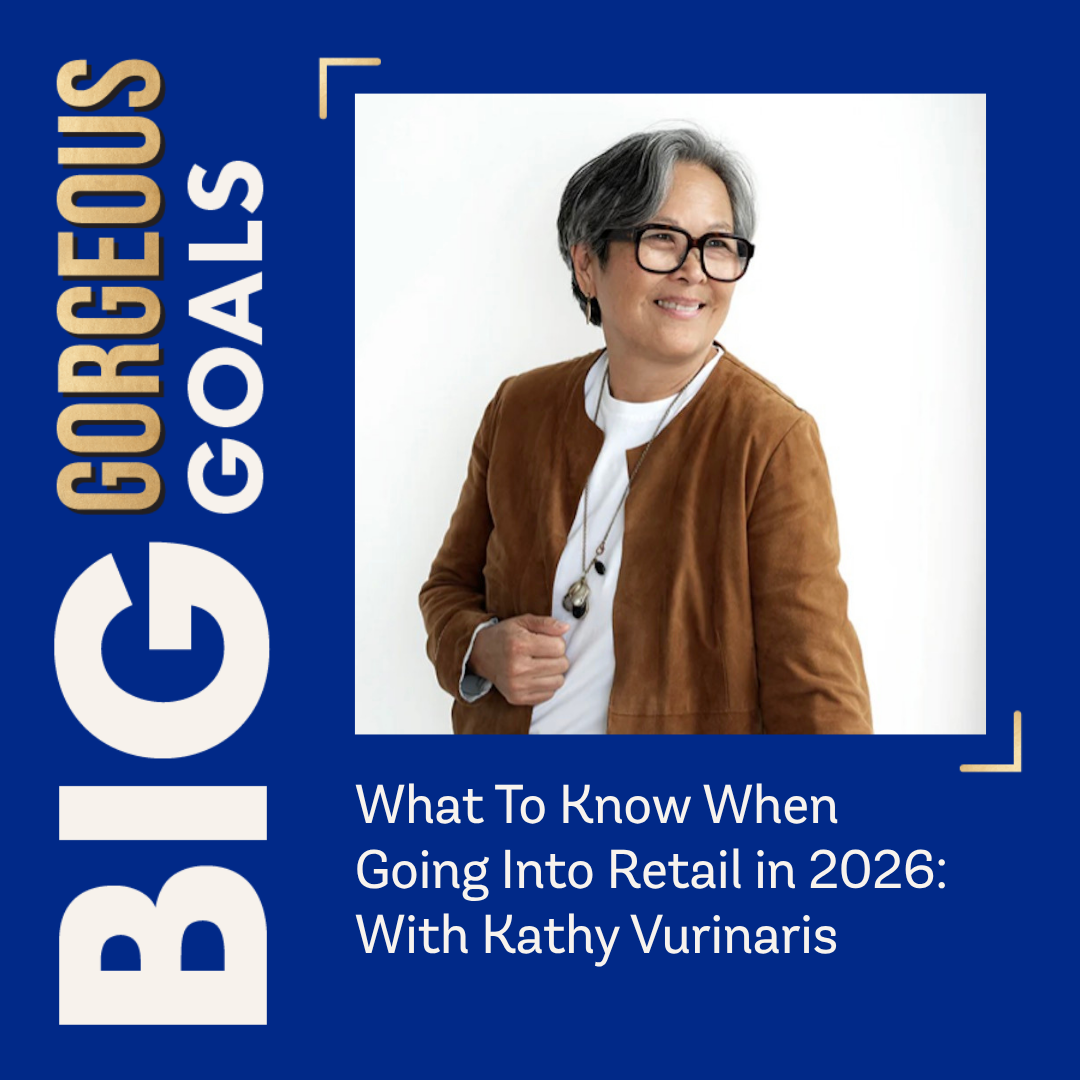
52. What To Know When Going Into Retail in 2026 with Kathy Vurinaris
EPISODE 52
Kathy Vurinaris, founder of Sleaks and veteran retail product development executive, joins Julie to launch a new series on selling to big retail. With experience on both sides of the table, Kathy cuts through the myths and shares what founders really need to know before pursuing major retailers.
Catch the Conversation



-
Kathy is a seasoned retail product development executive behind some of Canada's most iconic brands, including Joe Fresh, Club Monaco, and Roots, with experience at major retailers like Sephora and Loblaws.
Inspired by her 88-year-old mother's passion and wisdom, Kathy took on the challenge to confront a societal taboo, and created Sleaks. Scientifically researched, patent-pending washable leakproof underwear that looks and feels like normal underwear. Discreet, affordable, and eco-friendly, Sleaks empowers individuals to live freely while reducing environmental waste.
Kathy's mission is rooted in responsible consumption, environmental stewardship, and helping people live their best lives.
-
00:03:49 - Meet Kathy Vurinaris: From Retail Insider to Entrepreneur
00:07:38 - Signs of Retail Readiness: What You Need Before You Knock on the Door
00:17:57 - Margins, KPIs, and the Hidden Costs of Retail
00:25:09 - Choosing Your Channel: DTC vs. Retail and When to Wait
00:29:29 - Closing Thoughts: Readiness, Presence, and What Comes Next
-
Julie: For so many product-based entrepreneurs, getting into retail feels like the dream. You imagine seeing your product on the shelf at Target or Walmart or Shoppers Drug Mart. You imagine scale, visibility, validation. You imagine customers discovering your brand in the wild and your business suddenly growing to a whole new level.
Julie: And listen, retail can absolutely be transformative, but what I've learned, both through building Mabel's Labels and through years of coaching entrepreneurs, is that retail is not only a growth opportunity, it's a completely different business model. And if you go in too early or without fully understanding what you're signing up for, it can create enormous pressure on your margins, your inventory, your cash flow, and your team.
Julie: That's why I wanted to create this series, 'cause I think there's a conversation missing in entrepreneurship right now in the product space. We hear a lot about landing the retailer, getting the meeting, getting on the shelf, but we don't talk enough about what happens after that, what retailers actually expect from you, how much working capital it takes, what happens when your product doesn't turn fast enough, or how easy it is to believe that more distribution automatically means more profit when the opposite can betrue.
Julie: Today's guest brings such a fascinating perspective to this conversation because she has lived both sides of it. Kathy Vurnaris is the founder of Sleaks. Sleaks is a product created to support women dealing with bladder leakage and incontinence, particularly during menopause and aging. Before becoming an entrepreneur, though, Kathy spent years inside the retail and product development world, working with major retailers and brands, including in drugstore, beauty, and consumer packaged goods categories.
Julie: So I think what makes this conversation really interesting is that Kathy understands retail not just as a founder chasing shelf space, but as someone who has actually sat on the other side of the table. And one of the things I appreciate most about this conversation with Kathy is not rushing into retail, although she absolutely could.
Julie: Instead, she's asking herself deeper questions. Is the brand established enough yet? Is there enough traction? Will the product actually turn fast enough to survive on shelf? Can the margins support the hidden costs that come with big retail? All of these are incredibly smart questions, because one of the biggest myths in entrepreneurship is that scale fixes everything.
Julie: Scale only works when the fundamentals underneath the business are strong, and sometimes the most strategic decision you can make is to wait, to build your direct-to-consumer business first, to strengthen your messaging, to understand your customer more deeply, to create more demand before you create distribution.
Julie: In this episode, Kathy and I are talking about the realities of retail readiness, what founders need to understand before pursuing retail partnerships, the financial and operational risks that often get overlooked, and why having a great product is only one small part of succeeding in retail. So if you've ever dreamed about seeing your product on shelves, or if you're actively pursuing retail right now, this conversation is going to help.
Julie: It's gonna give you a grounded, strategic lens on what that path really looks like. Let's dive in.
Julie: Hello, and welcome to this new series about bringing your product-based business to big retail. Today I am speaking with Kathy Vurnaris, who is the founder of Sleaks, and we're gonna get to talking about her product-based business and why she founded Sleaks and what it's for. But Kathy's also, in her pre-entrepreneur days, she is a seasoned retail product development person.
Julie: And so I think it's interesting because, you know, as she says in her own bio, Sleaks is the culmination of her professional journey. She made products for others, uh, and, you know, now she's brought that into her own entrepreneurial venture, thinking about branding and product development and how the strategy of how you sell converges.
Julie: And so I'm really excited to have her on board with me for this series, where we're gonna talk about her business and also your business, and about whether going into retail is the right thing for you. Welcome, Kathy.
Kathy: Thanks, Julie. I'm so glad to be here.
Julie: Yeah. So tell me a little bit more about Sleaks.
Kathy: Sleeks started, um, it's interesting. It started; my 80-year-old mother is my muse. Um, and I was in between jobs and looking for an opportunity, and I, um, my, I moved my mommy to a home, uh, two years ago, and she w-moved from her her home who, which had a bathroom, you know, really close by, but in the home she was moving into it wasn't close.
Kathy: So she said, "Take me to Shoppers Drug Mart, and l-help me find a solution because I'm not gonna make it to the bathroom in the middle of the night." So standing in front of the incontinence aisle, she said to me, "I am not wearing disposable diapers. You need to design something for me." So, you know, I, uh, thought, "Yeah, this is a great opportunity for me.
Kathy: This is a space I know." I came from Drug. Um, I had launched, you know, a, like, a 13 categories in Shoppers Drug Mart under the brand of Fresh. And so yeah, this is a space I knew really well. And I, and, and also what I realized, there was a huge gap in the market.
Julie: Yeah. Yeah. And that's where, you know, I think the best businesses get started, is the, the, like noticing in that moment where we decide, "Ah, nobody's doing this, and I think the world needs it."
Julie: My, um-Yeah ... my mother needs it, so that means it's-... even more.
Kathy: Yes, exactly.
Julie: Yeah.
Kathy: So, yeah. Yeah. And, you know,
Julie: I think-Good. And so you've been now through a whole product development cycle, and you've-Yeah ... actually launched your product and it is for sale on your website.
Kathy: Yeah. It really is. Yeah. So, and the other thing that we're doing is we're actually affiliating with medical clinics because it is-Yes
Kathy: a medical product, and particularly focused on the menopause phase, 'cause what I've realized is the customer is younger than I thought it, thought, than I thought they were. Yeah.
Julie: Interesting. Yeah. Isn't it interesting how you start with a hypothesis really, um, and as you gather more data points, things do shift and change, don't they?
Kathy: Yeah. They really do. Yeah. Yeah. And you know, your customer tells you, right? As, you go into a, a, a business, you start a business with a lot of assumptions, right? Mm-hmm. Yeah. And then you launch, and then you really learn what your, who your customer is-Yeah ... who the product is resonating with.
Kathy: And you know, that's one of the things that I would say that's one of the biggest learnings as an entrepreneur, as a startup, is learning to pivot. Yeah. Like, really, really watching and pivoting fast. And you know, as a lot of people would say, failing fast because realizing, you know, like, that's the wrong thing and I need to do something different.
Julie: Yeah. Yeah. So I'm curious about, you know, as somebody who is building a brand now and who has brought lots of things to the retail market, how do you know, what's your cue to understand when a brand could be ready to go to retail?
Kathy: Uh, you know, it's, I come from a corporate background. Mm-hmm. So for me, I'm very, um, due diligence and, and, um, all of that is, is kind of ingrained in how I think.
Kathy: So I'm really, I think I really did it from a, I built a really strong foundation before I went to market. Yeah. And I think that there's a few fundamental things that, as a founder, you need to look at. You know, like, uh, gross margin, net profit, um- yes... you know, market opportunity, uh, you know, things that a lot of people don't look at- yeah.
Kathy: Until it's too late.
Julie: Right. Well, and I mean, just from my own experience, I think that, you know, even when I thought I was ready to go to retail, and I mean, the first retailer that we sold to, Mabel's Labels, was Walmart in Canada.
Kathy: Big one.
Julie: And we went into all, like, 400 stores across the country, and even thought thought we were ready, we had no idea what we were getting ourselves into.
Kathy: Yeah. Yeah. I mean, they have really high demands, right? And, and y-Yes ... you know, the other thing too is they have processes and built-in costs that a lot of people don't factor in.
Julie: Yes.
Kathy: And because I come from that g-that kind of business, like, n-I know that. So I've gone in, like, I believe that, we always said it at, when I was at Loblaws, that eight times cost was really where we needed to be.
Julie: Yeah.
Kathy: And I went in 10 times cost.
Julie: Right.
Kathy: Just 'cause, you know, the market's shifting, foreign exchange is shifting. You know, I, I really wanted to pad for a lot of those things that were unknown.
Julie: Yeah. Yes, because it's one of those things, you know, they, uh, the, the old adage, right? It's easy to get easier, but it's hard to get harder.
Julie: Yeah. And that definitely, I think, applies because once you're in and you have a deal signed, renegotiating that if you're not making money, you're not gonna do it.
Kathy: No.
Julie: So, so what would you say, like, the things that need to be working in your business before you even think about going to retail? Margins..
Kathy: Well, margins.
Julie: We talked about it a little bit. Yeah.
Kathy: Yeah. But I also think that for me, I think that, you know, you need to know what the expectations and the KPIs are for them.
Julie: Mm-hmm.
Kathy: And you need to know whether or not your, your product can actually meet their KPIs. 'Cause that's all they really care about, right?
Julie: Yeah.
Kathy: So what are their KPIs? Turnover is a huge one. So one of the reasons why I've actually decided to pull back and not go into retail-
Julie: Mm-hmm ...
Kathy: is because I don't feel like my brand is well-established enough-
Julie: Right ...
Kathy: for me to actually get the turnover that's required for them-Mm-hmm ...you know, in, you know, the last thing I wanna go, to do is go into somebody like a Shoppers and sit on the shelf. Like, there's-
Julie: Right ...
Kathy: That would, there'd be nothing worse than that. You know, their expectation, I know 'cause I was there. I sat on the other side of the table. The expectation is 60%turnover-in 90 days.
Julie: Right. So-So just to be clear on what that means, that means for every 10 items that go on the shelf, they want six of them to sell within 90 days.
Kathy: Yeah. Yeah. Exactly. Yeah. And that's a really, even for an established brand-
Julie: That's a big expectation
Kathy: That's a huge- yeah... expectation.
Julie: Yeah.
Kathy: And you know, the, you know, the, and their terms are, they, their terms can be really punitive if you do not meet those KPIs.
Julie: Yeah. And, and you know, as a small brand, like, they're not gonna negotiate their 80-page contract with you.
Kathy: No.
Julie: And I do remember that. Pretty self-explanatory. I remember having the contract, y-you know, some of the first contracts we signed for big retail, um, reviewed by a lawyer and basically saying-They're not gonna change anything for me. I know this. So the lens I want you to put on your review is, what are the pitfalls for me?
Julie: What do I need to know?
Kathy: Right.
Julie: Yeah.
Kathy: And that's why for me it's like understanding what their expectations are and working backwards to that. Right. Can you achieve those expectations?
Julie: Yeah. Yeah, and when you say, you know, your brand doesn't have enough traction, how much traction is enough? What should people be thinking about when they, when they try to evaluate that?
Kathy: You know, going into a big retailer, I think that either there's nothing compared to that, and you, you know, I also think that you have to have their support. You need to have their commitment that they're going to promote your brand and promote your product. 'Cause without that as well, you know, so you have to have traction, but you also have their, have to have their support as a as a big retailer. Um, so yeah, I, for me, I don't know. I, I would say that you need to, people need to know who your brand is and what your product is just by saying the name, by going-That's-... into one of those big national retailers.
Julie: Yeah. Yes, and I would say in Canada when we went to Walmart and appeared on the shelf, we had the following built in our direct to consumer online business that we push people into the stores. Um, but the places, you know, we didn't have the support we needed were in, you know, was the product actually on shelf in the store that person was gonna go into, had it made it out of the back room. Right.
Kathy: Like, I think there's a lot of things that we can dive into as we get a little farther into this conversation about-
Julie: Right ... what it's like when you actually get there. Um-Yeah. But in terms of readiness, I think we had the traction, um, and the ability to, um, withstand the really long payment cycles. You know, you're-Yes ... paying for something- That's true, yeah ... getting it made overseas, bringing it in, and waiting all that time to get paid, so.
Kathy: Right. Yeah. And the other thing too is if you're not an established brand, and this we can get into this in more detail, you're not gonna be a priority to be paid either. Yeah. So if your terms are 90 days, the likelihood is you're gonna get paid in 120-Yeah ... even though the terms say 90, right? So. Yeah.
Julie: Yep, and it just, yeah, depends who you're working with.
Kathy: Correct.
Julie: Who do you think, I mean, you talked about why you're not gonna pursue retail. Yeah. What are some other reasons not to pursue retail, or who shouldn't be pursuing retail?
Kathy: Wow. Um, well, I think that anybody who, you know, if you have a product that your category is crowded, that's somebody who's also, like, so Ialso come from a cosmetic background.
Kathy: I was at Sephora. You know, and I think that just in as example, um, skincare's a really crowded space. Right?
Julie: Mm-hmm.
Kathy: If you think that you're go on... And so a lot of brands of skincare, their goal is to be in Sephora. But if you don't have a really distinct point of differentiation within that category, uh, retail's a gonna be a really big struggle for you.
And, you know, their terms are also very similar to, you know they're a big retailer, global retailer as well. So, you know, I think that that, um, you know, uh, know your competition, I think is a really, really, really important one. Um, so yeah, I speak to a, uh, you know, I'm in a lot of groups with a lot of other startups, and a lot of them are product-based companies.
Julie: Mm-hmm.
Kathy: And if you ask them what their point of differentiation is, they look at you like a deer in the headlights, and they don' they, they don't even know 'cause they've never even thought about it
Julie: Right. Yes. Because they're down the rabbit hole. They believe so strongly in what they're doing, right? But yes, you've got to, on a retail shelf, in a lineup of eight or 10 or[00:16:00]12 products, you've gotta be able to, you know, for people to understand what it is you do and why.
Kathy: Right And, you know, that's where branding is important. You know, packaging, all of those things.
Julie: Yeah.
Kathy: It's, you know, I think those are really important.
Kathy: You know, you think about the wor- Mabel's Labels as an example.
Julie: Yeah.
Kathy: The name is catchy, right? Yes. It, that's really important.
Julie: Yeah. Yes. It's super important. And, you know, we had already, you know, eight or nine years of brand recognition in a direct to consumer environment before we did go into retail.
Julie: But that is one thing I think of. Uh, I think that it seems like it will be scale, right? To go to retail. Mm-hmm. Yeah. It feels like, well, if I get into, you know, 2,000 Target stores or 2,200 I think they might have now-
Kathy: Yeah
Julie: it's going to be scale. I'm automatically going to. And it, the, you know, it isn't necessarily true.
Julie: Um, the second part I find about it is that it's a whole different business with a completely different kind of PNL than a direct-to-consumer e-commerce business.
Kathy: Absolutely. Yes. I mean, direct to consumer is high margin, right? Yeah. Because there's the overhead. You control all of the overhead, right?
Julie: Yeah.
Kathy: Um, and so it's very, very different. Yes. Whereas, you know, there's a lot of cost that goes into, that you're paying for the retailer that's selling it.
Julie: Yeah. Yeah, yeah. It's true. And there's always seemingly more costs they want you to take on for them, so. Absolutely. That part never ends. The negotiating-It doesn't
Julie: is never done, right?
Kathy: No. Yeah. Yeah, yeah. Yeah. You gotta pay for your own discounts. You've gotta... You know, it's like, it, and-Yeah ... you don't know when that's gonna happen. Yeah. So you just-Y-you kind of, you have to go in knowing-
Julie: Yeah ...
Kathy: the depths of that contract. So going back a little bit now to your eight to 10 times cost-Yeah
Julie: uh, for retail price or for sell-in-Yeah ... for sell-in, right? Yeah. Which means it's actually like 16 to 20 for, you know, um, for MSRP, manufacturer suggested retail price. No, no. No, eight to 10 from your cost.
Kathy: Eight to 10, 10 from cost for your retail. Yeah.
Julie: Okay. Yeah. Yeah. And so, you know, I think direct to consumer you're seeing people more between 25 and 50%, right?
Julie: As opposed to that, like, 10 to 12 and a half percent, if we go back, if I think about it as percentages, right? 'Cause if you're at a 10% cost means you have a 90% gross margin, and I think direct to consumer is more like 25% cost,75 to 40 or 50 cost-Yeah ... to gross margin of 50 or 60.
Kathy: Yeah. Yeah.
Julie: And you can run a very, you can run a profitable business on that.
Kathy: Direct to consumer.
Julie: Yes.
Kathy: But if you think you can go retail, you're never gonna make money.
Julie: Right.
Kathy: Yeah. Unless you do your own vertical retail, but that's a whole different conversation.
Julie: Right.
Kathy: Right?
Julie: Right. So. And you're talking, like, Joe Fresh opened their own stores, right? I'm sure there's other examples. Well, I think NYX is probably another example It's a, it's a great example ...where they opened their own stores. Right. Because I mean, although they're very big now, they ha-you know, they are entrepreneur company, right? Founded. Yeah. Yeah. Yeah. Um, yeah. And so that's the interesting piece as well, I think, in terms of, you know, when you're small and you have choices all the time with limited resources, both sides of the business, the direct to consumer and the retail side, I think is incredibly difficult.
Kathy: Very. Very. And very different. You, you really do have to wear completely different hats.
Julie: Mm-hmm.
Kathy: Cause they're very different verticals.
Julie: Right. Yeah. Yeah. And how do you see, like, as somebody who's in the market now and obviously talking to lots of other entrepreneurs who wanna go into retail and are, who are chasing-Yeah
Julie: that at the moment, what do you see in terms of, like, how are they doing it? Because in my experience, which is a little bit longer ago, um-Yeah ...finding the right people to hire on my internal team to manage the retail business was very, very difficult.
Kathy: Yeah. Well, you know, what I started to do is I hired a salesperson whose background is selling into drug.
Julie: Okay.
Kathy: And so I had built-Yeah ... that cost. So, you know, I, I know kind of what they expect to be paid and, you know, what kind of commission they expect and all of those things. So I actually, I'd worked on a straight commission kind of basis.
Julie: Yeah. but the reality is, is that to go into the kind of retailers that are appropriate for my...
Kathy: Well, you also have to think about the kind of retailers that are appropriate for your business. Yes.
Julie: Right? Yep.
Kathy: And so for me-Yep ... it's drug. What I realized- for sure it
Julie: is, right ...
Kathy: right, yeah. Yeah. Because, you know, 73% of all incontinence products are sold at drug stores. So it makes-
Julie: Not surprising to me.
Julie: No, and then the second, the second category would be stores like Walmart, like those superstore kind of formats.
Kathy: Yeah, absolutely. Yeah, yeah, yeah. Exactly. Yeah. Um, and so, and drug grocery is actually one category. It, it's l-Yes ... and that's how it's looked at in the indus-in sort of retail. Um, actually, uh, the, so the other category would be specialty on lingerie. So-Oh, yeah ... like the underwear department of-Interesting ... yeah, the underwear department at Simon's, as an example, is-Yeah ... would be a target, right?
Julie: Yeah.
Kathy: Um, so, uh, so because that's more destination.
Julie: Yeah.
Kathy: Right? For that-Yes ... kind of specialty product.
Julie: And, and like, uh, going all the way back to what you said about your mom at the very beginning, that your mother said, "I'm not wearing those," think that a lot of women feel that way, right? Yeah. And so they're surviving on less than ideal, um, solutions. Solutions. Wearing, wearing-Yeah ... you know, pads and those kinds of things, right?
Julie: So, um-Yeah ... to have you be able to buy a beautiful looking product in a not-incontinence aisle of the drugstore is likely appealing to people.
Kathy: Right.
Julie: Mm-hmm.
Kathy: Exactly. But what I realized is that to go into the grocery, drug grocery,I needed to have a distributor.
Julie: Yes.
Kathy: Right? And I wasn't, I'm not prepared. I just don't think I'm ready for
Kathy: Again, because their goal is to sell. Yeah. Their goal is to put you on shelf. Yeah. But if my brand isn't well-recognized enough-
Julie: Yes ...
Kathy: that's, that's a recipe for failure-
Julie: Right ...
Kathy: in my mind, right? 'Cause like I, I said previously, there's nothing worse than having your product out there but just sitting.
Julie: Yes.
Kathy: It's
Julie: sad. Well, also because, you know, y-although you're gonna get paid forit eventually, um-
Kathy: Not necessarily. If,
Julie: if you don't meet the KPIs ... you know, you get into returns and you get into, like all your money is tied up in that inventory that's sitting on shelves, and you-Yes ... re-un-really unlocking that money depends on-the item starting-Turn, yes
Julie: to get some velocity and turn off the shelf-Correct ... right?
Kathy: Correct.
Julie: Mm-hmm. Yeah.
Kathy: So, yeah, so I, you know, I've completely made a pivot. Yeah. I'm actually right now doing a course on Shopify optimization.
Julie: Great.
Kathy: Um-So important,
Julie: right?
Kathy: By Shopify. Um-Yeah ... and it's about messaging. It's about, you know, it's about convers-like it's about-Yeah
Kathy: all of those KPIs-Yeah ... that, uh, you know, and they have the data, right? They, they know what works and what doesn't. Yes. So I've decided to lean into that instead.
Julie: Yeah. Yep, and I think that, you know, you can keep yourself in a smaller, like, y-y-one team kind of format, right? When you-Yeah ... when you're tackling one revenue stream
Julie: Yeah. And you can build the brand. You can do all the things that might be able to build the bridge over to going into retail down the road.
Kathy: Right. Yeah.
Julie: Yeah.
Kathy: Yeah.And, you know, if I don't go into retail for two years, I'm good with that.
Julie: Yes. Yeah. Yes. And-And that is sort of comes to that, like, what are the things people need to get right before they go to retailers?
Julie: It's to really get good at selling what you have, knowing that your product market fit is there. Correct. Um, and, you know, really digging in and learning the technicalities in today's-Yeah ... world of running a direct-to-consumer e-commerce firm.
Kathy: Right.
Julie: Yeah.
Kathy: And so many people, regardless of age now, are buying online.
Julie: Yes.
Kathy: They're, like, they just are. Yeah. Um, uh, like I've a, uh, I'm not gonna name the brand, but I, you know, I know somebody who has an underwear brand who has six, six styles, and does $42 million a year direct to consumer with a team-Yep ... of six.
Julie: I know.
Kathy: Right?
Julie: That sounds like a business I would love to own.
Kathy: Me too. Right? Yeah. So that's the goal, right? So if I achieve something like that, I don't need to be in retail.
Julie: Yeah. No, exactly
Kathy: And at that point, hopefully-
Julie: Yeah ...
Kathy: based on my contacts and the people that I know, people will be, retailers will be wanting me. Those big retailers, like the Shoppers and the Walmarts they'll be knocking on my door.
Julie: Yes. Yes.
Kathy: Right? Yeah. And I have greater negotiating power then.
Julie: Yes. Also true, because you get into, like, the financial costs of inventory and inventory management, but also listing fees-Yep ... you know, um, kitting, shipping, delivery, like, all those different components-All those things, yes
Julie: that come into play.
Kathy: I mean, I've already built in the cost of PDQs and floor stands-Yes ...and all of those things just 'cause I know how much they cost, and I know that that's the expectation of a lot of retailers. Yeah. But a lot of people don't know that. So-
Julie: Yeah ...
Kathy: like I know how to build a profitable planogram.
Julie: Yep.
Kathy: Right?
Julie: Yep.
Kathy: Cause that's what I had to do.
Julie: Yep.
Kathy: A lot of people don't know how to do that. So how to make-Mm-hmm... a small amount of product look like it's a lot-Yes ... but that will
turn quickly, right? Yeah, yeah. So those are the kinds of tricks that I would say are to my advantage that a lot of-Yeah ... a lot of, you know, entrepreneurs and startups with product-based businesses don't know.
Julie: Yeah.
Kathy: Because they, they ... You know, when you're really passionate about your product, you don't think that way, right? No. No, and
Julie: it's-
Kathy: Right? You just wanna get it out there.
Julie: Yeah, and I think we don't realize how technical it actually is. Uh-huh.The, you know, it has its own ... I mean, you just threw out a whole bunch of terms there.
Julie: Uh, right? But-Sorry ... that, no, but like a PDQ is a box that you can rip open, and it's shelf ready, and you put it on, and your product is there. You see them at Walmart or other-All ... Processors ... now I see them everywhere, everywhere. End caps,
Kathy: Yeah ... yeah.
Julie: End caps. Yeah. At the end of an aisle, the display that goes there.
Julie: Correct. Like-
Kathy: Yes ...
Julie: all of those things, like you're learning this whole new language and this whole... And, uh, so we'll, we'll put a glossary of terms to go with this episode-... just because of how specific the language is that goes with it.
Kathy: Yes.
Julie: Yeah. Um, yeah. So, okay, so I wanna kinda close off here by saying, so the readiness and the reality are, are the first step of deciding whether you're gonna pursue retail
Julie: Um-Right ... and I think that it is that, like you need more money than you think, finding, you've gotta find the right experts to help you. Um-Yep ...you've gotta decide if you've got the margins for it. Mm-hmm. Um, and if you don't, uh, it brings with it a lot of risk that we'll talk about in the next, um, episode.
Julie: Yeah. Um, and then, you know, you've gotta really, really keep it tight.
Kathy: Yeah.
Julie: You know, one thing I learned with a big US retailer-Assortment ...assortment, they, they-
Kathy: It's really
Julie: tight ... you know, and yeah, and we had a big r-US retailer where they took us, and then the buyer changed, and the new buyer wasn't the same champion. And so they, they slimmed the assortment down to two SKUs on one peg, and it didn't sell. And we got-Yeah ... delisted a year later because it didn't sell.
Kathy: Right, right.
Julie: And we knew it wasn't gonna sell-'Cause you also need a minimum presence ... but we didn't wanna walk away. Oh. And it's the less mo-the biggest lesson: we should have walked away.
Kathy: Yes.
Kathy: Because you need a minimum presence as well, right? As much as you need to have an edited assortment- yeah... that's on you know is gonna turnover a, turnover of your best products. Yes. You also have to have enough of a presence- yes... to attract customers
Julie: Yeah. To, to, for people to find you.
Kathy: So people can find you. Yeah, exactly.
Julie: Okay. Well,-We're gonna go onto execution, and I can't wait to dive into this more.
Kathy: Okay.
Julie: Okay.
Julie: Thanks so much for joining me in this special series on retail strategy for product-based businesses. I hope these conversations gave you a more honest, practical, and strategic look at what it really takes to grow through retail. And perhaps even more importantly, how to decide whether retail is the next right step for your business at all.
Julie: One of the things I've learned through entrepreneurship is that there is no single path to building a successful company. Some brands thrive in retail, some thrive direct to consumer, some build hybrid models, and some discover that scaling sustainably means saying, "Not yet," or even, "Not for us." All of those decisions can be smart ones.
Julie: The key is understanding the realities behind the opportunity, so you can build intentionally instead of reactively. If this series sparked questions for you about growth, leadership, scaling, retail strategy, or the operational side of building a product-based business, I'd love to support you further.
Julie: You can learn more about my work, coaching, speaking, and the Big Gorgeous Goals framework at www.julieellis.ca. And if you're a founder navigating growth decisions in real time, you can also learn more about my pocket coaching program. It's a voice note-based coaching designed to give entrepreneurs strategic support, perspective, and decision-making guidance exactly as you need them.
Julie: Because sometimes the most valuable thing in business it's not another course or another framework. It's about being able to have the right conversation at the right moment. If you enjoyed this series, I'd love for you to subscribe to the podcast, leave a review, or share it with another entrepreneur who's trying to decide what growth should look like for them.
Julie: Thanks again for being here, and until next time, keep chasing your Big, Gorgeous Goals.